
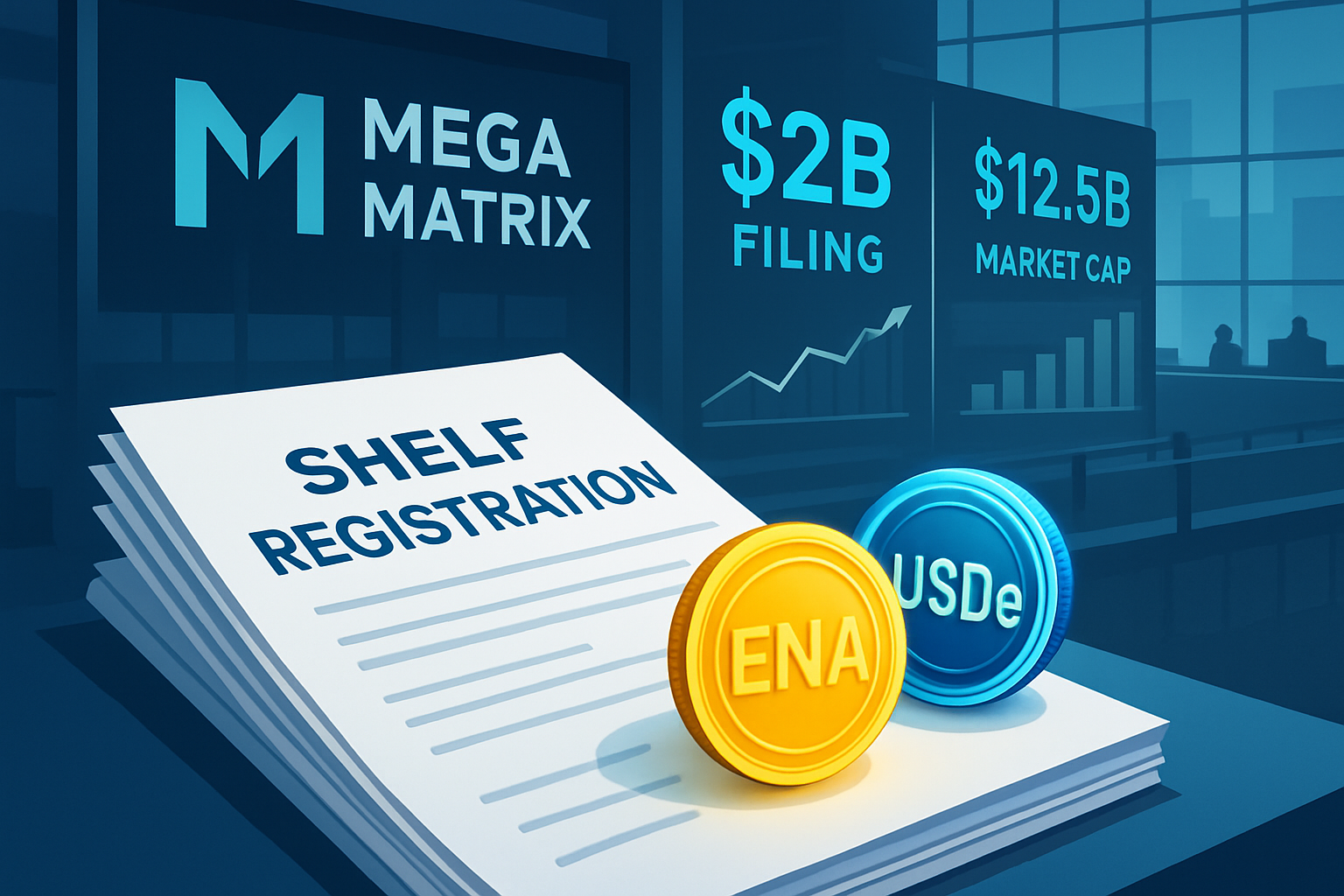

Mega Matrix, a publicly traded portfolio company, is making a notable shift into digital asset management by filing a $2 billion preliminary registration with the U.S. Securities and Exchange Commission (SEC) to acquire Ethena’s ENA token. This move symbolizes a significant bet on the future of stablecoins in an evolving financial landscape.
Investment in ENA Token as a Strategic Move
The funds raised through the preliminary registration will be exclusively allocated for accumulating ENA, the governance token of the Ethena protocol. Ethena operates USDe, a synthetic stablecoin designed to maintain a dollar peg using collateral secured by perpetual contracts.
Unlike traditional fiat-backed stablecoins such as USD Coin (USDC) or Tether (USDT), USDe generates yield from market financing rates of derivates. Once Ethena’s “fee switch” mechanism is activated, ENA token holders are expected to receive a share of the protocol’s revenues, offering investors an indirect avenue to capture the returns generated by USDe.
By concentrating its investments in ENA, Mega Matrix aims to secure governance influence within Ethena and capitalize on potential revenue generated by the protocol’s innovative business model. The company’s decision is driven by the rapid growth of Circle, the issuer of USDC, and the expanding role of digital asset treasuries.
The U.S. GENIUS Act, which prohibits issuers from paying yield directly to stablecoin holders, is seen as a regulatory factor that may further boost demand for synthetic yield alternatives like USDe.
Ethena’s Rapid Growth in the Stablecoin Market
Despite its relatively new model, Ethena Labs, the developer behind USDe, has experienced impressive growth. In August, the company reported that cumulative gross interest revenues surpassed $500 million.
According to CoinMarketCap, USDe’s market capitalization reached $12.5 billion, marking it as the third-largest stablecoin globally. Though still significantly smaller than fully-collateralized competitors such as USDT and USDC, Ethena’s distinctive structure and yield-generating capabilities are positioning it as an emerging player in the stablecoin market.
Investors are closely monitoring this growth, seeking stablecoin models that transcend traditional fiat-backed structures.
Risks and Industry Context
Mega Matrix’s $2 billion preliminary registration is particularly noteworthy given its modest market capitalization of $113 million. The company reported revenues of $7.74 million in the first quarter, alongside a net loss of $2.48 million, with its core business still focused on FlexTV, a short-form streaming platform.
Earlier this year, Mega Matrix also purchased $1.27 million in Bitcoin, signaling a gradual transition toward digital assets. This pivot is not unique; other firms like ETHZilla, BitMine Immersion Technologies, SharpLink Gaming, and Bit Digital are pursuing similar cryptocurrency-focused treasury strategies.
However, analysts caution that these approaches carry significant risks. Josip Rupena, CEO of lending company Milo, has compared yield-generating digital asset engineering to collateralized debt obligations (CDOs) from the 2008 financial crisis, warning that investors often underestimate their exposure.
As Mega Matrix embarks on its Ethena-centric strategy, it underscores both the appeal and the risks associated with digital asset treasuries. The company’s success may hinge on the sustained growth of USDe and the overall stability of the cryptocurrency ecosystem.
